
ECOblocks are a 100% viable construction solution, combining masonry and insulation in one element. Apart from being eco-friendly, they are a competitive and affordable alternative, reducing operations, materials and labour.
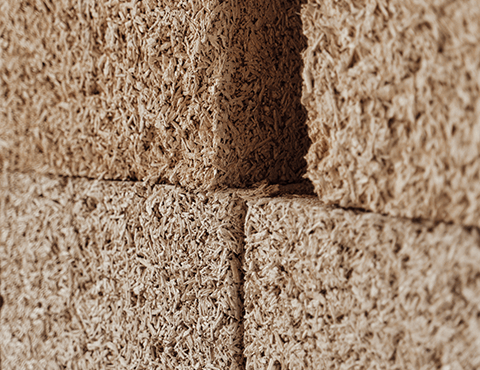
ECOblocks are made of 100% natural raw materials: hemp shives, lime, clay and water.
ECOblocks can be used on both. We have seven different thicknesses which can be adapted for either inside or outdoor walls made from scratch or as insulation for pre-existing walls (renovations). When used on renovations, ECOblocks are not only suitable as additional thermal insulation, but also help to solve damp and mould issues.
There are many types and brands of thermal bricks on the market, with very different capabilities. Nevertheless, the vast majority have insufficient thermal capacity and need to be insulated – this is known as an external thermal composite system. With ECOblocks there is no need for additional insulation. The ECOblock25 has a higher thermal resistance than most combined solutions of thermal brick + external thermal composite system. The ECOblock15 already fulfils the requirements for outside walls in most parts of the country, while the ECOblock32 is incomparable with other building materials on the market due to its higher comfort and thermal resistance.
Yes, ECOblocks have a higher alkaline pH due to the presence of lime in its composition, which works as a natural pest repellent. Furthermore, hemp also has naturally repellent features – hemp plantations do not require pesticides or herbicides. ECOblocks act as natural pest repellents.
They have an estimated durability of between 75 and 100 years based on scientific and case studies since the 1980s in France, and subsequently in the rest of the world.
This longevity is linked to the lime carbonation process, which increases mechanical resistance over time. Its breathing capability regulates temperature and humidity, preventing certain pathologies and reducing the need for maintenance.
Additionally, lime-based constructions have proved to be more durable than cement over the decades, and even millennia, as verified by the buildings left by the Romans. Even though cement has initial advantages, with time it loses these properties, whilst lime maintains its features and reinforces them over time.
No, ECOblocks are not structural, just like traditional masonry in Portugal. Therefore, a structure is needed. In Portugal, structures are usually made of cement but wood or metal structures are also viable options.
ECOblocks do not burn. During the production process, lime coats the hemp shives and petrifies the material during the curing process. ECOblocks might slightly degrade but they do not burn in case of fire. Additionally, they do not spread flames and do not emit toxic gases, making them a safe and natural solution.
ECOblocks have undergone rigorous fire resistance tests, confirming their ability to withstand up to 240 minutes without burning, emitting toxic gases or allowing them to pass through.
ECOblocks comply with current building regulations, having undergone rigorous testing by certified entities. All their technical features — such as their thermal and acoustic resistance, carbon footprint and fire resistance — are official and validated. Even though they are an innovative product, we follow the standards established in the construction sector to ensure quality and safety.
ECOblocks fulfil several criteria of these certifications, such as the use of sustainable materials, negative carbon footprint, energy efficiency and reduction of waste. In projects that look for these types of certificates, ECOblocks will help accumulate points in the categories of eco-friendly materials and energy efficiency.
The ECOblocks guarantee is their technical data sheet. All tests follow international norms and standards and have been carried out by certified labs.
The durability of the solution depends on their application. Cânhamor has technical support to monitor the process, from the project phase to the completion of ECOblock operations.
Beyond simply presenting the cost, it is essential to understand the solution as a whole. The ECOblock is equivalent to masonry + insulation + labour: these are not needed as three separate processes when using ECOblocks. Therefore, it is not fair to compare the price of one ECOblock with one brick or an insulation board. You can check our price table, which also includes the cost per m2, making it easier to compare with the total cost of other solutions.
ECOblocks offer a complete solution combining masonry and insulation. They should not be compared directly with traditional masonry or insulation. With ECOblocks you eliminate the need to use a double wall and/or add insulation, thus reducing the amount of building materials used, as well as the number of procedures and associated labour. The most accurate way to compare the cost of this solution with another one, is always by m2 of finished wall.
For interior walls we recommend the ECOblock15. For walls that require more thermal/acoustic features, like semi-detached walls, we recommend the ECOblock20. We have hemp blocks with specific thickness for each of your thermal needs – 25, 28.5 and 32cm. For technical information you can check our Application Manual or contact our technical department.
ECOblocks require natural hydraulic-lime based mortar to maintain the breathability of the blocks and prevent the formation of thermal bridges — something that would occur with cement-based mortar. The plastering and finishing methods are similar to conventional wall systems, so no specialised tools or labour are required.
To insulate pre-existing walls we recommend ECOblocks with a thickness of 7 or 11 cm. The thicker the lining, the greater the insulation, but this comes with an added cost.
These linings are supported by a starter rail or a waterproof support. At each 2 m2 we also use metal connectors so that there is no separation between the pre-existing wall and the ECOblocks lining.
ECOblocks do not require specialised knowledge or tools. Any builder or bricklayer can apply them, using the same methods applied to laying conventional bricks. For technical information please check our Application Manual or contact our technical department.
Grooves can easily be made with angle grinders and milling cutters, amongst other tools. The waste generated can be reused in the mortar to fill gaps, reducing the amount of waste and rubbish.
For technical information, please check our Application Manual here or contact our technical department.
If you are having trouble finding builders, talk to us! We will gladly put you in touch with professionals who have already worked with our ECOblocks.
Yes, Cânhamor delivers anywhere in Portugal, including the islands. We work with several carriers to guarantee the most competitive prices, without making any additional profit. Contact us.
The Cânhamor factory was designed to serve both the domestic and Spanish markets (Iberian market). If you wish to order ECOblocks to another country, it can be done but it will have an impact on the final cost and on the environment, due to the additional transport required.
No, you can only buy ECOblock pallets direct from Cânhamor or from one of our representatives.
Yes, hemp can be grown anywhere in Portugal, even though the quality of the soil and the specific climate of the growing area will influence production.
Cânhamor is reintroducing hemp crops on an industrial scale in Portugal, so we have protocols with partner farmers. To ensure the agreed quality of the hemp bales, we constantly monitor all stages of cultivation (from seed to baling). Farmers have to commit to following our instructions on how to grow hemp, and we assume the position of the end buyer. After validating the quality of the final product, we buy hemp by the tonne, in dried bales.
The main requirement is that the farmer has an efficient irrigation system, like a pivot system, to optimise hemp production and a high yield. This system not only ensures uniform water distribution, but it is also essential for optimal plant development, especially in areas with periods of drought.
Hemp is a plant with various benefits for farmers, such as:
- Soil sustainability and improvement: hemp promotes soil regeneration, naturally enriching it with nutrients, which is ideal for crop rotation and can improve soil quality over time. Further to this, it doesn’t require a lot of water to grow and it has a very organic growth.
- Low water consumption and easy organic cultivation: hemp doesn’t require a lot of water to grow and easily adapts to organic farming practices, becoming a sustainable and easy to maintain option.
- Economic performance: with growing demand, hemp offers producers a competitive market value. In just four months, it produces a high amount of dry biomass (7 – 10t).
- Resistance to pests: hemp is a naturally pest resistant crop, having no need of pesticides, thus reducing both economic and environmental impacts.
 Please wait